06 Jan 2026 • Payal
Tata Sierra EV 2026: Pricing, Launch Date, and Why It’s the Most Anticipated EV
The Tata Sierra EV 2026 is set to mark the return of an iconic name in a modern electric avatar. Expected to launch in 2026, the Sierra EV promises a strong mix of nostalgic design, practical SUV space, modern features, and a competitive electric range. This blog explains the expected pricing, launch timeline, battery and range details, key features
Tata Motors’ revival of the Sierra nameplate as an all-electric SUV has stirred a lot of excitement — and not without reason. The Sierra was an icon in India during the 1990s, and bringing it back as a modern electric SUV signals Tata’s intent to combine nostalgia with cutting-edge EV technology. If you're curious about when it will arrive, how much it might cost, and whether it’s really worth the hype, this long-form guide walks you through everything in simple, human terms. I’ll explain the likely pricing, what to expect at launch, why people are so excited, how it compares with Tata’s other EVs, and how to decide whether to wait or buy now. I’ll also add a short note from carjd.com about the Sierra’s market positioning and finish with a thorough FAQ to answer the practical questions students, families, and car buyers usually ask.
Why the Sierra EV matters (and why people are paying attention)
The Sierra name brings instant recognition. Beyond nostalgia, though, the Sierra EV matters because it’s part of Tata’s bigger electric strategy: a line-up that ranges from the compact Nexon EV to larger models like the Harrier EV and now the Sierra.ev. Tata has steadily invested in EV platforms, battery tech, and charging infrastructure; the Sierra is not just a one-off retro exercise — it is a serious product designed to compete in a growing EV market. For buyers, that means a combination of practical family-friendly packaging, modern technology, and Tata’s growing EV support network.
People are excited for three reasons in particular:
- Iconic name + modern tech — a classic reborn as an EV.
- Practical family SUV shape — enough space for 5–7 occupants depending on layout.
- Tata’s EV learnings — Tata is reusing mature tech and lessons from Nexon.ev, Curvv, and Harrier EV projects to deliver a better product faster.
Launch date: when will the Sierra.ev reach showrooms?
Tata has publicly confirmed that the Sierra EV will be launched in the 2026 window. Multiple credible automotive news outlets and Tata’s own EV roadmap references point to a 2026 commercial launch, with several reports narrowing that to the first half of the year (Q1–Q2 2026) for India. This aligns with Tata’s broader schedule of introducing multiple EVs across segments during 2025–2027. If you’re planning to wait for the Sierra.ev, expect formal announcements, pre-booking windows, and dealer-level information to start appearing in the months before the official launch.
Practical tip: keep an eye on Tata’s official EV site (ev.tatamotors.com) and the major auto portals for the exact launch day and booking details. Official events and press releases are the most reliable source; dealer teasers sometimes appear earlier but can vary by region.
Expected pricing: what will the Sierra.ev cost?
Price at launch is one of the biggest unknowns — and also the detail buyers care about most. Early and repeated reporting from Indian auto portals in late 2025 and early 2026 suggests a fairly wide expected price range. Different sources estimate:
- A conservative starting range around ₹15 lakh (ex-showroom) for the base variant in some forecasts.
- Other mainstream outlets and price trackers point to a broader ₹16–25 lakh band depending on battery size, single vs dual motor variants, and optional features — with premium variants possibly touching the ₹20–25 lakh bracket.
Why such variation? Because EV pricing depends heavily on the battery pack size (kWh), motor configuration (single or dual motor / FWD or AWD), local incentives or taxes, and optional features like ADAS, premium audio, and big infotainment screens. Tata may offer more than one battery option or variant package to hit multiple price points — for instance, a lower-range, more affordable variant and a longer-range premium variant with higher tech and AWD. Expect the base Sierra.ev to be positioned between Tata’s compact offerings (like Nexon EV) and the larger Harrier EV — creating a “sweet spot” for families wanting a roomy, tech-focused SUV.
Practical consumer advice: if price sensitivity is your top factor, wait for Tata’s final pricing and look for early booking offers. If you value range and tech, budget for a mid-to-high variant where the battery pack and features justify the cost.
Range and battery: how far will it go on a charge?
Range is another area where early reporting suggests encouraging numbers. Several outlets mention a claimed range in the region of 400–500+ km on a single charge for the larger battery option, with more conservative estimates for smaller pack variants. Reports indicate Tata might use battery technology and pack options similar to those in the Curvv EV (55 kWh) and Harrier EV (around 65 kWh), and could offer both a mid-range pack and a long-range pack to cater to different buyers.
What that means in real life:
- A 55 kWh pack: good for daily city use and moderate highway driving — expect realistic real-world WLTP/IDC-style numbers lower than the claimed figure (maybe 300–420 km depending on driving style).
- A 65 kWh pack: targets long-range buyers and highway travel — real-world ranges closer to the claimed 400–500 km in ideal conditions.
Keep in mind: claimed range figures are often measured in controlled conditions. Real-world range depends on speed, AC use, terrain, passenger load, and driving style. Still, offering a 400+ km claimed range option would make Sierra.ev a strong long-distance choice among Indian EVs.
Performance and drivetrains: single-motor or dual?
Tata is likely to offer multiple powertrain options to appeal to families and performance seekers alike. The typical mix — based on recent Tata launches and industry patterns — could be:
- A single-motor, FWD variant tuned for efficiency and daily usability (the most affordable option).
- A dual-motor, AWD or higher-output variant aimed at buyers who want stronger acceleration, towing confidence, or better handling in rough-road scenarios.
Why this matters: AWD variants often carry a price premium but deliver better traction and a sportier feel. Single-motor variants are cheaper, lighter, and more efficient. Tata’s experience with the Curvv and Harrier EV suggests they can use modular components to deliver these different options without heavy cost penalties.
Design and packaging: what the Sierra.ev brings to the segment
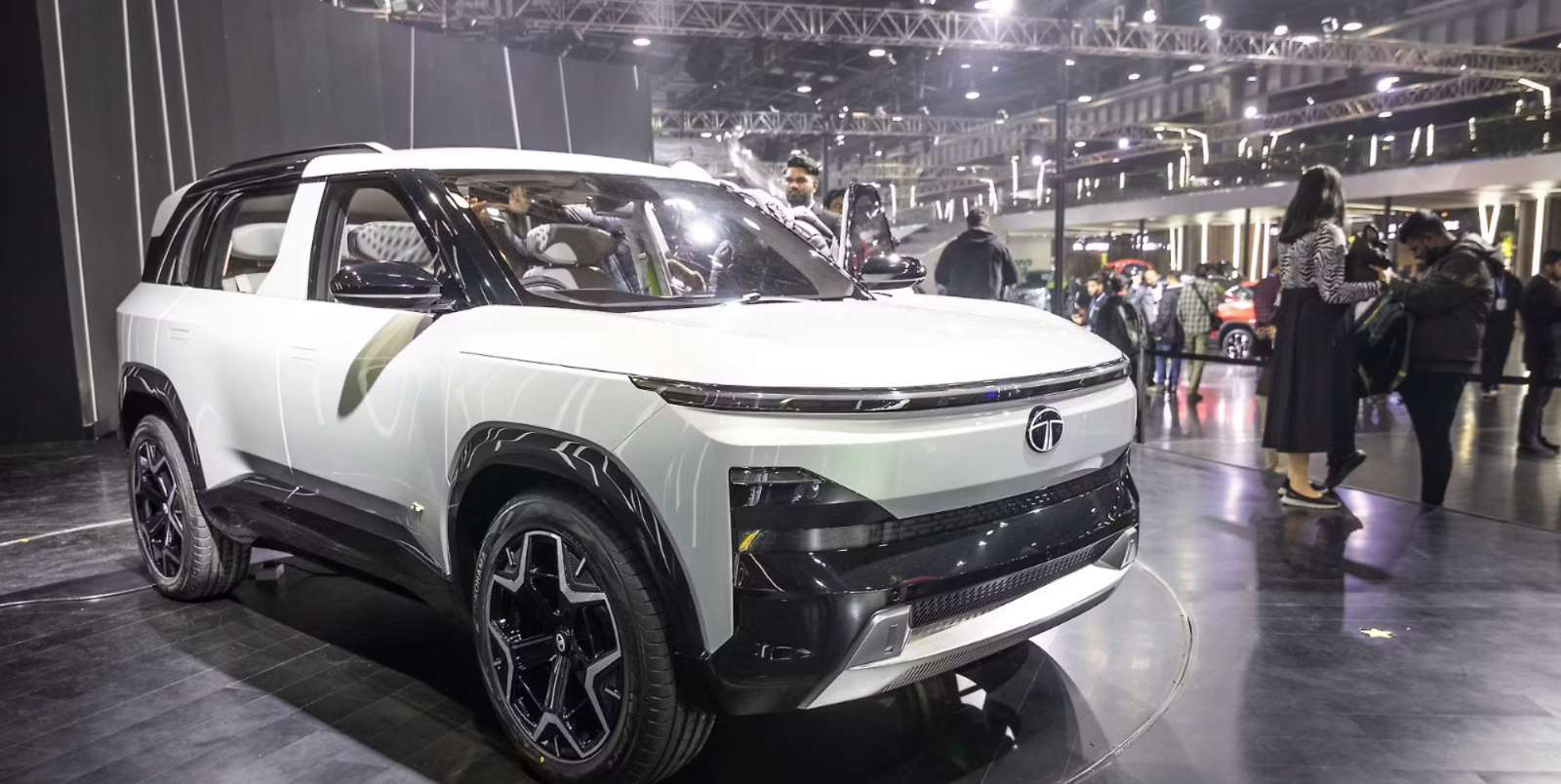
The Sierra.ev follows Tata’s current design language — bold, squared-off, and distinctly SUV-like — with a modern twist. Expect:
- A strong, upright silhouette with characteristic Sierra cues (wraparound rear glass in the ICE Sierra’s spirit).
- Sharp LED lighting signatures front and rear, a modern grille/face appropriate for EVs, and a muscular wheel-arch treatment.
- A practical, spacious interior with options for a panoramic sunroof, flexible seating layouts (5- or 6/7-seater variants likely), and lots of usable storage.
The Sierra’s appeal will partly come from packaging: a roomy cabin, good boot space, and a family-friendly ergonomics layout. Tata has learned that buyers in India value practical touches — multiple USB ports, useful door pockets, and comfortable seats more than some flashy but impractical gimmicks. The Sierra.ev seems targeted to deliver on that practicality.
Interior tech and features: modern, comfortable, and connected
Expect the Sierra.ev to be well equipped with technology appropriate for its segment:
- A large central touchscreen running connected-car features (Tata’s current software stack supports smartphone mirroring, OTA updates, and connected services).
- Digital driver display and heads-up display options on higher trims.
- Level-2 ADAS suite (adaptive cruise control, lane-keep assist, AEB, etc.) — Indian media reports indicate the Sierra.ev will carry modern driver assistance features with better calibration than older systems..
Comfort features likely include dual-zone climate control, ventilated front seats on higher trims, adjustable driver seats with memory, and a premium sound system. The overall goal appears to be a balanced mix of comfort and daily usability rather than niche luxury-only touches.
Charging and Tata Power integration
Tata’s EV strategy is closely tied to its larger automotive and energy ecosystem, including Tata Power’s charging infrastructure. Buyers of Sierra.ev should expect:
- Support for DC fast charging (with reasonable charging times depending on the battery pack).
- Home charging solutions and partner promotions via Tata Power EV Charge network.
- Likely support for 0–80% fast-charge times in under an hour on higher-power CCS chargers for bigger battery variants (exact timings will be published by Tata at launch).
Practical note: fast charging speeds depend on the car’s onboard charging architecture and the charger’s power rating; advertised numbers are often “up to” figures. For daily use, a reliable AC home charger and occasional DC fast charging for long trips is the pragmatic plan.
Safety: Tata’s emphasis (and expectations)
Tata has built a reputation in India for prioritising safety across its models and the Sierra.ev is expected to continue this trend. Expect:
- Multiple airbags, strong structural integrity, and modern safety technology.
- Standard electronic stability control, hill-hold, tyre pressure monitoring, and a 360-degree camera package on higher variants.
- Aiming for competitive safety rating(s) such as Bharat NCAP once the car is crash-tested — Tata emphasizes safety as a value proposition in the Indian market.
How the Sierra.ev fits into Tata’s EV lineup (and why that matters)
Tata’s EV portfolio is becoming broad: Nexon.ev (compact SUV), Curvv/other crossovers, Harrier EV (larger SUV), and now Sierra.ev. The Sierra.ev sits in the family-friendly C-SUV space, positioned to attract buyers who want more space and features than the Nexon.ev but prefer slightly lower cost or different packaging than the Harrier EV.
This positioning is strategic: it fills a gap in Tata’s ladder where many Indian families look for the best mix of price, space, and features. For buyers, that means more choices and more chance to find the exact fit for budget + space + range requirements. The Sierra.ev could be the “sweet spot” for many households who want a modern EV with practical space without moving to a top-end premium model.
A short paragraph from carjd.com (market context & positioning)
CarJD, a respected auto news portal, points out that the Sierra.ev will create a unique niche between Tata’s smaller EVs and its larger electric SUV offerings. The outlet highlights the Sierra.ev’s probable 6/7-seater configuration, family-oriented packaging, and the likelihood of multiple battery/motor options which create a flexible price-and-feature matrix for buyers. In short, carjd.com frames the Sierra.ev as a strategically important product that brings Tata’s EV learning to a broad family audience, helping Tata capture a bigger slice of India’s transition to electric mobility.
Ownership costs and real-world running
One reason EVs are becoming more attractive in India is the total cost of ownership (TCO). While the upfront price of an EV like the Sierra.ev may be higher than an ICE equivalent, savings on fuel, lower maintenance (fewer moving parts), and potential state incentives can make ownership economical over 3–5 years.
Key practical considerations:
- Electricity cost vs petrol/diesel per km — charging at home overnight is cheaper per km than petrol for similar vehicles.
- Battery warranty — recent Tata EVs come with multi-year guarantees on the battery pack; expect similar warranty coverage on Sierra.ev which reduces long-term anxiety about battery replacement costs.
- Resale value — early adopters and those buying well-priced variants often see healthy demand in used EV markets; the Sierra’s brand recognition will help. Tata Motors EV
Who should consider the Sierra.ev?
The Sierra.ev is likely the best fit for:
- Families who need space (5–7 seats), comfortable ride, and modern features.
- Commuters with occasional highway needs who benefit from a longer-range battery option.
- Buyers who value safety and connected features and want a mainstream EV with strong aftersales support.
- People who like the Sierra’s style and practical packaging, but want modern EV economics.
If you’re a city-only buyer with tight parking and a strict tight budget, a smaller EV like Nexon.ev could still be a better match. But for those balancing range, space, and features, the Sierra.ev appears to be a top contender in its segment.
Pre-booking, delivery expectations, and timing
Based on Tata’s previous launches and recent reporting, the timeline looks like this:
- Teaser and media launches in the months before commercial launch (Tata often teases design and features).
- Pre-bookings via Tata’s official portal and dealers ahead of the showroom launch (dealers sometimes open token bookings earlier).
- Delivery starts in the weeks after official launch; priority is often given to higher trims and urban regions first.
Because demand for Sierra.ev is expected to be strong, early booking could help you get your preferred variant sooner — but always read booking terms and refund policies carefully, especially for dealer-level tokens vs official Tata bookings.
How to decide: buy now or wait for Sierra.ev?
This is the question many buyers face: do I buy an existing EV (Nexon.ev, Harrier EV later) now, or wait for the Sierra.ev? A balanced way to decide:
- Immediate need: If you urgently need a car (daily commute, family needs this month), buying an available model makes sense.
- Budget flexibility: If your budget accommodates a mid-to-high variant and you want the Sierra’s space/features, waiting could be worthwhile.
- Technology patience: If you’re comfortable waiting for refined new tech and model-specific features (longer range, better ADAS), wait for Sierra.ev reviews and first-hand owner feedback.
- Incentives and offers: Keep an eye on incentives, trade-in offers, and launch discounts; first-year offers often include servicing or accessory packages that add value.
If you prefer an immediate purchase, Tata’s current EV lineup remains excellent. If you want the latest family-focused EV with high range and features, waiting for Sierra.ev is reasonable. Either way, plan test drives, compare battery sizes, and think about long-term ownership costs.
Potential downsides and realistic cautions
No car is perfect. For Sierra.ev, consider:
- Price uncertainty: Final pricing may be higher than some early estimates, especially for AWD/long-range variants.
- Real-world range variance: Claimed 400–500 km range may drop under heavy usage, AC on, or cold/hot conditions.
- Waiting time: New launches sometimes face initial supply constraints and long waiting lists.
- Service network load: While Tata has a strong service network, EV-specific service demand could create early teething issues in some regions.
Mitigation: read independent long-form reviews once the car is out, wait for long-term owner feedback if you’re very conservative, and check the warranty and battery terms carefully.
Deep dive: Features likely to matter most to Indian buyers
Here are some Sierra.ev features that will matter more than flashy extras — and why:
1. Comfort and ergonomics
People who drive daily care about seat comfort, ride quality, and cabin ergonomics. Tata tends to get these right and will focus on usable comforts like seat ventilation, lumbar support, and good rear legroom.
2. Practical storage and usability
Door pockets, usable console space, and a flexible boot are small things that make daily life easier. Sierra.ev’s family focus suggests good practical storage design.
3. Real-world ADAS usability
Features are only useful if they work well in Indian traffic. Expect Tata to refine ADAS calibration for Indian conditions — smoother lane assist, better ACC behavior in stop-and-go traffic, and robust object detection.
4. Charging flexibility
Home charger options, bundled wall boxes, and integration with public charging networks like Tata Power will be important. Expect bundled offers or partner discounts at launch.
5. Software and updates
OTA updates, in-car user experience, and a fast infotainment UI are more important than an extra speaker or two. Tata has improved software responsiveness across recent models.
These practical areas often influence buyer happiness more than headline specs.
What reviewers will test first (and why these matter)
When the Sierra.ev is finally launched and journalists drive it, the review checklist will likely include:
- Real-world range across city/highway mix.
- Charging speed and thermal management (how the battery performs under repeated fast-charging).
Ride and handling — especially at typical Indian road conditions.- ADAS calibration and usability.
- Cabin noise and comfort at highway speeds.
These tests show whether the Sierra.ev is truly ready for Indian buyers or whether it’s a concept tuned for good numbers on paper. Wait for several independent reviews to get a clear picture.
FAQ — everything you want to know (short answers, simple language)
Q: When will the Tata Sierra EV launch?
A: Tata has confirmed a 2026 launch window. Keep watch on official Tata announcements and major auto portals for the exact date.
Q: What will the Sierra.ev cost?
A: Early estimates place the Sierra.ev in a broad band — roughly ₹15–25 lakh ex-showroom depending on the variant and battery size. Exact pricing will be revealed at launch.
Q: What is the expected range?
A: Reports suggest options that may deliver 400–500+ km claimed range for the larger battery variant; smaller packs will have lower claimed ranges. Real-world figures will vary.
Q: Will there be AWD or dual-motor variants?
A: It’s likely Tata will offer multiple powertrain options, possibly including an AWD/dual-motor variant for higher performance trims.
Q: How long will battery charging take?
A: Fast charging (DC) could charge the Sierra.ev to 0–80% in under an hour depending on charger power and battery size; home AC charging will take longer. Exact numbers will be quoted by Tata at launch.
Q: Should I wait for the Sierra.ev or buy another EV now?
A: If you need a car now, buy a current EV that meets your needs. If you can wait and want the Sierra.ev’s space/features, waiting for the launch and reviews is sensible. Consider your budget, urgency, and feature priorities.
Q: Will Tata offer an official home charger and installation support?
A: Likely yes — Tata often bundles or offers partner deals for home chargers through Tata Power and dealer networks. Confirm at booking.
Q: Are there government incentives for EV buyers?
A: Many state governments offer incentives for EVs (subsidies, registration fee waivers, tax benefits). These vary by state and model, so check local policies for the Sierra.ev nearer to launch.