03 Mar 2026 • Payal
Fastest Cars in the World: Speed & Power Explained
The fastest cars in the world are not just about extreme top speeds; they represent the peak of automotive engineering, combining massive horsepower, advanced aerodynamics, lightweight materials, and cutting-edge technology. From record-breaking hypercars like the Bugatti Chiron Super Sport 300+ to powerful electric contenders, the race for speed continues to push boundaries. Explore how speed and power truly work in the modern automotive world.
Speed has always captured human imagination. From the earliest racing competitions to modern Formula 1 circuits, the desire to go faster has driven innovation. In the automotive world, this passion has produced some of the most extraordinary machines ever created — the fastest cars in the world. These vehicles are not simply modes of transportation. They are the result of years of engineering research, technological breakthroughs, and relentless ambition.
When we talk about the fastest cars in the world, we are not just discussing numbers on a speedometer. We are talking about power, precision, aerodynamics, advanced materials, and extreme performance. Understanding how these cars achieve such unbelievable speeds requires looking beyond the surface.
In this detailed guide, we will explore what truly makes a car fast, examine some of the fastest cars ever built, explain the science behind speed and horsepower in simple words, and understand why these vehicles represent the pinnacle of automotive engineering. If you are passionate about high-performance cars, hypercars, or automotive innovation, platforms like carjd.com regularly provide insights, comparisons, and detailed car analysis to keep enthusiasts informed.
Let’s dive into the fascinating world of extreme speed.
What Does “Fastest Car” Really Mean?
When people ask, “What is the fastest car in the world?” they usually mean the car with the highest top speed. However, speed in the automotive world is more complex than just one number.
Top speed refers to the maximum velocity a car can reach under ideal conditions. This is typically measured on closed tracks or controlled environments because public roads are not suitable for such extreme performance.
But speed is not only about how fast a car can go at its maximum. Acceleration is equally important. Acceleration measures how quickly a car can reach a certain speed, usually from 0 to 100 km/h (or 0 to 60 mph). Some cars may not have the absolute highest top speed but can accelerate incredibly quickly, giving drivers an intense experience.
Horsepower and torque also play crucial roles. Horsepower reflects the engine’s overall power output, while torque measures rotational force. Together, they determine how powerfully and efficiently a car moves.
Therefore, when evaluating the fastest cars in the world, engineers and enthusiasts consider multiple performance factors, not just top speed alone.
The Science Behind Extreme Speed
Achieving extreme speed is not simply about installing a powerful engine. It requires a balance between power, aerodynamics, weight distribution, and control.
Engine Power and Horsepower
The engine is often described as the heart of a car. In hypercars, engines can produce more than 1,000 horsepower. To put that into perspective, most regular cars produce between 100 and 300 horsepower.
Hypercars achieve this extraordinary output through advanced engineering techniques, including turbocharging and supercharging. These systems force extra air into the engine, allowing more fuel to burn and producing greater power.
However, power alone does not guarantee speed. Without proper control and design, excessive power can make a car unstable.
Aerodynamics: Fighting Air Resistance
As a car moves faster, air resistance increases dramatically. At extremely high speeds, air becomes the biggest obstacle. Engineers design hypercars with sleek, streamlined shapes that reduce drag and allow the vehicle to cut through air smoothly.
Many of the fastest cars in the world feature active aerodynamics. This means certain parts of the car, such as rear wings or air vents, automatically adjust depending on speed and driving conditions. These adjustments help maintain stability and reduce lift, keeping the car firmly planted on the ground.
Without advanced aerodynamics, even the most powerful engine would struggle to push a car beyond certain limits.
Lightweight Materials and Structural Strength
Weight plays a major role in performance. The heavier a car is, the more power it needs to move quickly. That is why hypercars are built using lightweight materials such as carbon fiber and aluminum.
Carbon fiber is both extremely strong and lightweight. It allows engineers to create rigid frames that can withstand high speeds without adding unnecessary mass.
Balancing weight and structural integrity is crucial. A car traveling at over 400 km/h must remain stable and safe.
Some of the Fastest Cars Ever Built
Over the years, several manufacturers have competed to break speed records. These cars represent the highest level of automotive performance.
Bugatti Chiron Super Sport 300+
The Bugatti Chiron Super Sport 300+ made headlines when it surpassed 300 miles per hour. This milestone was historic because it demonstrated that production-based cars could reach speeds once thought impossible.
Its quad-turbocharged W16 engine produces over 1,500 horsepower. The engineering behind this car reflects decades of refinement and innovation.
SSC Tuatara
The SSC Tuatara has been part of intense discussions in the automotive community due to its claimed record-breaking speeds. Designed with advanced aerodynamics and a powerful twin-turbo V8 engine, it showcases the relentless pursuit of performance.
Koenigsegg Jesko Absolut
Koenigsegg is known for pushing boundaries. The Jesko Absolut is designed specifically to maximize top speed. Its lightweight construction and powerful engine allow it to compete among the fastest hypercars in existence.
Hennessey Venom F5
The Hennessey Venom F5 aims to exceed 500 km/h. With a highly engineered twin-turbocharged engine and precision aerodynamics, it represents America’s contribution to the hypercar speed race.
Electric Hypercars and the Future of Speed
Traditionally, the fastest cars relied on massive combustion engines. However, electric vehicles are now entering the speed competition.
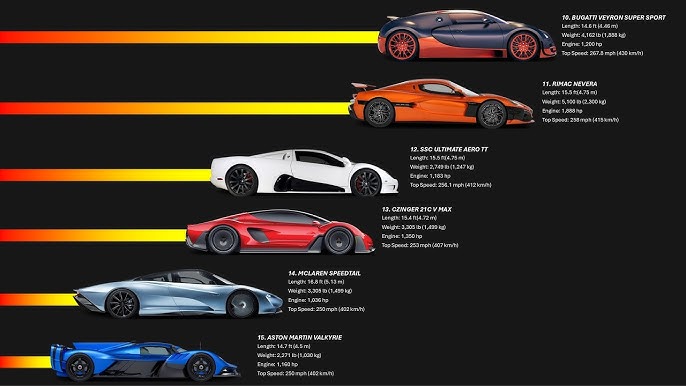
Electric motors provide instant torque, meaning they can accelerate incredibly quickly. Cars like the Rimac Nevera demonstrate that electric hypercars can rival traditional performance machines.
As technology advances, the future of speed may involve hybrid systems combining electric motors with combustion engines for even greater performance.
For regular updates and performance breakdowns, car enthusiasts often explore carjd.com, which covers both electric and traditional high-performance vehicles.
The Cost of Extreme Speed
The fastest cars in the world are incredibly expensive. Prices often exceed several million dollars. Limited production numbers make them rare collector’s items.
Maintenance costs are also high. Tires designed for extreme speeds must withstand enormous pressure and heat. Replacing them can cost thousands of dollars.
Owning a hypercar is not simply about driving fast. It is about possessing a piece of engineering art.
Safety and Record Verification
Speed records are carefully verified under controlled conditions. Manufacturers must perform runs in both directions to eliminate wind advantage. GPS technology is used to confirm accuracy.
Safety is a priority. These cars feature advanced braking systems, reinforced chassis structures, and electronic stability controls to manage high-speed conditions.
Why Fastest Cars Matter
Most people will never drive at 400 km/h. So why do these cars matter?
They push technological boundaries. Innovations developed for hypercars often influence everyday vehicles. Improved braking systems, lightweight materials, and aerodynamic designs eventually become standard features in consumer cars.
Hypercars serve as testing grounds for the future of automotive technology.
Final Thoughts: The Endless Pursuit of Speed
The fastest cars in the world represent more than numbers. They symbolize human ambition and innovation. Engineers constantly challenge what is possible, striving to go faster while maintaining safety and control.
Speed is not just about breaking records. It is about mastering physics, engineering, and design.
For enthusiasts who want to explore performance comparisons, emerging technologies, and in-depth automotive analysis, platforms like carjd.com provide valuable insights into the ever-evolving world of cars.
The race for speed never truly ends. As technology advances, new records will be set, and new legends will emerge.
Because in the world of automobiles, pushing limits is part of the journey.