09 Feb 2026 • Payal
ADAS Level 2 in 2026: Which Budget Cars Now Offer Autonomous Safety Features?
ADAS Level 2 is no longer limited to luxury cars. In 2026, several budget SUVs and sedans now offer autonomous safety features like adaptive cruise control and lane assist. Discover which affordable models include ADAS and how to compare them smartly before buying.
If you’ve been shopping for a car in 2026, there’s a good chance you’ve heard the phrase “ADAS” — Advanced Driver Assistance Systems — a dozen times. That’s because driver-assist technology has stopped being an exclusive premium-car feature and has moved steadily down the price ladder. Today, many manufacturers offer Level 2 ADAS in mainstream and even budget models. But what does that really mean for everyday drivers? Which affordable cars actually come with Level 2 systems, and how should you choose one?
This article explains Level 2 ADAS in plain language, explores which budget models in India and comparable markets offer authentic Level 2 features in 2026, weighs the benefits and limits of these systems, and gives practical buying advice you can use at the dealership. I’ll also show how a comparison site such as carjd.com can help you line up variants, ADAS feature lists, and prices so you make an informed decision.
What “Level 2” ADAS actually is — and what it isn’t
People often confuse marketing language with actual capability. “ADAS” is a broad umbrella that includes everything from a reversing camera to lane-centering and adaptive cruise control. To make sense of it, regulators and automotive bodies use a 0–5 scale of automation. Level 2 means the car can control steering and acceleration/deceleration simultaneously under certain conditions, but the human driver must stay attentive and keep hands on the wheel. In other words, Level 2 is partial automation: useful and sometimes impressive, but not “self-driving.”
Where Level 1 might give you cruise control or a single steering assist, Level 2 systems combine several assists — lane-keeping or lane-centering, adaptive cruise control (including stop-and-go in some systems), automatic emergency braking (AEB), blind-spot detection, and sometimes traffic sign recognition. The system can drive the car on a straight highway stretch; it cannot, however, take responsibility for unpredictable urban situations, sudden obstacles, or legal decisions the way a human driver must. Expect better comfort, improved safety margins when systems are used properly, and fewer low-speed collisions — but also the need for constant human supervision.
Why Level 2 matters for ordinary drivers (and why you should care)
For many buyers the appeal is straightforward: ADAS features reduce fatigue on long drives and help prevent common mistakes that lead to crashes. Adaptive cruise control keeps you at a safe following distance without constantly easing the accelerator; lane-keeping assistance helps avoid drifting; AEB can prevent or reduce the severity of frontal collisions. Together, these features make driving less stressful and safer — especially for families who use the car for daily commutes and weekend highway trips.
Equally important: once automakers install the sensors (cameras, radar, ultrasonic sensors) and the software, the safety benefits are immediate and measurable. For budget-conscious buyers, the trick is to find models that offer genuine Level 2 capability at a price that makes sense. That’s exactly the shift Indian buyers saw through 2024–2026: features that used to be luxury options became available in mainstream compact SUVs and sedans, sometimes limited to specific top trims. If you’re comparing three or four models, a site like carjd.com helps you compare the exact list of ADAS features in each variant (which is crucial — ADAS is often not available across all variants), plus on-road prices and ownership costs.
The short list: budget models offering Level 2 ADAS in India (2026 snapshot)
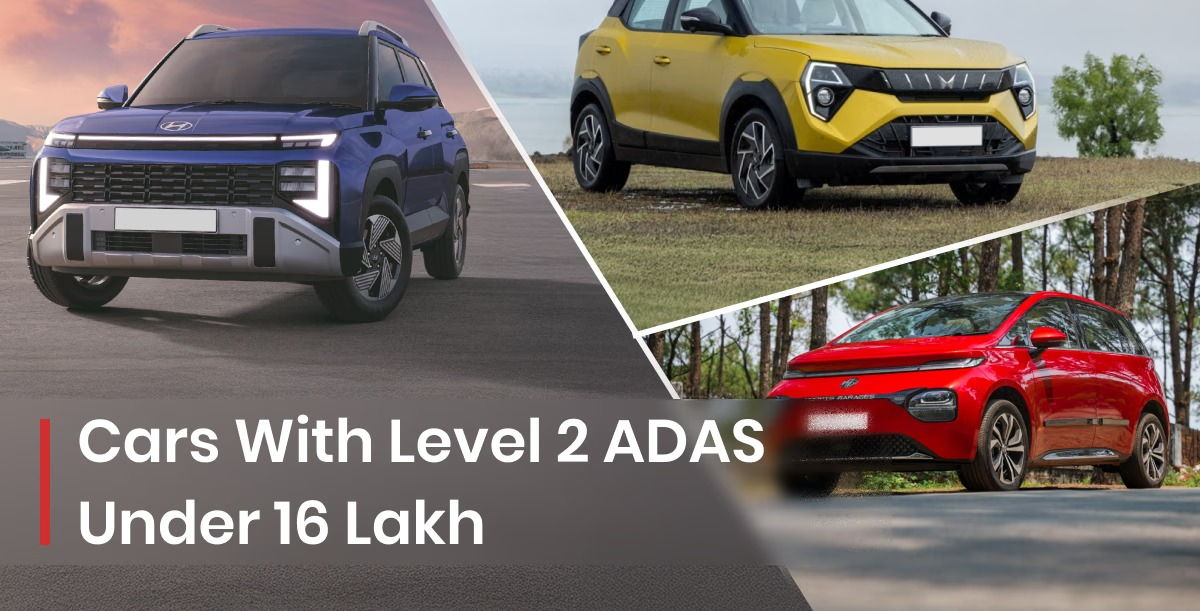
By late 2025 and into 2026, several mainstream brands brought Level 2 ADAS to the Indian market — often reserving them for higher trims, but sometimes placing them within surprisingly affordable price bands. Important examples (with the caveat that availability can depend on variant and region) include small sedans, compact SUVs, and mid-size SUVs. These models represent the most accessible Level 2 options for buyers in India:
- Honda’s small sedan lineup (including the Amaze) and its compact sedans such as the City and Elevate have Level 2 ADAS suites on higher-spec variants — in many cases these became some of the most affordable Level 2 cars in the market.
- Hyundai has pushed its SmartSense suite into mainstream variants in models like the Creta and Verna; the company lists Level 2 capabilities in its official materials for these models. These are among the most visible and well-documented mainstream ADAS implementations.
- Kia’s Seltos and other mid-range models have had Level 2 features available in GTX-level variants, offering a strong ADAS feature pack at competitive prices.
- Tata Motors rolled out ADAS in some of its popular models — most notably updated Nexon EV variants and higher trims of other models — delivering Level 2 features in an EV and ICE lineup that is popular with urban buyers.
- Mahindra refreshed its XUV line and launched the XUV 7XO / XUV700 variants with Level 2 ADAS in competitive price bands, signaling the company’s intent to bring advanced safety tech into mainstream SUVs.
Third-party automotive publishers and review sites have also catalogued many more models that now offer ADAS — in total, tens of mainstream models now offer some form of Level 2 functionality, but buyers must be careful: Level 2 capability is usually variant-specific, and some manufacturers limit certain features by engine, gearbox or trim. For a clean, side-by-side list of specific variants and prices, compare models on dedicated comparison sites like carjd.com, which shows exact variant spec differences so you don’t accidentally buy a model without the ADAS you want.
How “budget” we’re talking about
The word “budget” depends on perspective: in 2026 India, a “budget Level 2 ADAS car” often means a model where the ADAS-equipped variants come in under or around ₹13–18 lakh ex-showroom; a handful of models push that threshold lower or slightly higher depending on EV vs ICE, local taxes and trim. For many buyers, the important fact is that ADAS is no longer restricted to ₹30 lakh+ luxury vehicles; it’s increasingly available in the compact SUV and midsize sedan segments where volume sales happen.
If your budget is strict and you need ADAS at the lowest possible price, the most affordable options historically have been small sedans like the Honda Amaze (top trims) and compact SUVs in the sub-₹15 lakh bracket (on-road prices vary by city and variant). For complete variant-by-variant price checks, use a comparison tool like carjd.com to find which exact trim has the ADAS pack and what the total on-road cost will be in your city.
A closer look at notable models and why buyers liked them in 2026
In this section I’ll describe a few representative models and what their ADAS offers, so you can see the differences in real-world terms — not just buzzwords. I’ll avoid short bullet lists and explain each car in readable paragraphs.
Honda (Amaze, City, Elevate). Honda’s approach was pragmatic: bring a reliable set of ADAS functions to popular family sedans and entry SUVs, focused on driver support rather than headline-grabbing automation. For buyers, this meant adaptive cruise control that works smoothly in traffic, reliable lane-keep assist, emergency braking that detects pedestrians and vehicles, and blind-spot detection. Honda’s ADAS implementations earned praise for consistent camera-radar sensor calibration and sensible human–machine interaction. That translated to a real advantage for daily commuters who wanted stress reduction on highways without the headline cost. Automotive press and price-roundups in 2025–2026 flagged specific Honda variants as among the most affordable Level 2 cars.
Hyundai Creta & Verna (SmartSense). Hyundai’s SmartSense is a branded family of ADAS features that made its way into mainstream models. The Creta’s ADAS suite is often presented as an integrated package across camera and radar sensors, delivering lane-centering, adaptive cruise control, and collision avoidance. Hyundai’s strong dealer network and software updates mean owners frequently received calibrated systems and over-the-air adjustments in some markets — a practical benefit when sensors need recalibration after bodywork or trimming. Hyundai’s official site lists the SmartSense ADAS capabilities for models like Creta and confirms Level 2 functionality for select variants.
Kia Seltos. The Seltos has been a strong seller thanks to attractive pricing and solid equipment. The ADAS capability in GTX-level variants gives buyers a suite of features usually expected in pricier cars: adaptive cruise control with stop-and-go capability, lane keep, blind-spot monitoring, and advanced collision avoidance. For people who want SUV height and ADAS in the same car, the Seltos offered a tidy balance of price and feature content.
Tata Nexon (including EV variants). Tata moved ADAS into both ICE and EV variants in 2025–2026, and importantly offered it in the Nexon EV, which started at a higher price but carried ADAS as a value feature for EV buyers. The Nexon’s ADAS implementation included robust AEB and adaptive cruise features where applicable. Tata’s strategy of bundling safety into popular models appealed to families who prioritized crash-avoidance tech. Automotive write-ups also highlighted the Nexon as one of the most affordable ADAS-equipped SUVs in its category.
Mahindra XUV family (XUV700 / XUV7XO). Mahindra expanded ADAS into its larger SUVs, with the XUV 7XO launching with Level 2 features in competitive pricing. For buyers wanting SUV space plus ADAS, Mahindra’s updated line signaled that advanced safety tech had become a mainstream offering even in more rugged, value-focused SUVs. News coverage around the launches emphasized that ADAS alongside convenience features and camera systems made these models strong contenders for buyers who drive both city and highway.
Why variant-level checking matters: the trap most buyers fall into
One cautionary lesson from 2024–2026 is that ADAS rarely appears across all trims. Automakers often restrict full Level 2 suites to specific top-tier variants, combinations with automatic gearboxes, or EV powertrains. That means you can see an ADAS badge on a model’s brochure — but your chosen variant might not include the sensors or the software. Someone who buys a lower variant because it “looks the same” might be disappointed when they discover the car lacks ADAS. For example, ADAS might be available only with DCT/A/T automatic boxes or on petrol-DCT combinations in certain models.
That’s where a comparison tool becomes essential. Use carjd.com to compare two variants side-by-side and confirm whether the package you want is standard, optional, or unavailable. Compare sensor lists (camera, radar), ADAS feature lists (lane keep, adaptive cruise, AEB, blind-spot, traffic sign recognition), gearbox compatibility and the exact price difference. The last thing you want is to find out post-purchase that the auto-braking or lane assist isn’t present in your variant.
Real-world behavior: how Level 2 ADAS behaves on Indian roads
Indian roads are diverse and challenging: highway stretches and urban chaos exist in the same commute. Level 2 systems perform best in steady highway traffic with lane markings and controlled environments. The benefits are most visible on long commutes or multi-hour drives where fatigue is a factor. On city streets, where lane markings can disappear, irregular intersections and two-wheelers create complex scenes, Level 2 systems must be supervised closely and sometimes disengage.
In practice, buyers reported that ADAS reduces stress on long trips and provides a consistent safety net for common mistakes (like distracted lane drift). But ADAS is less of a help in chaotic urban driving unless you’re selective about when to entrust the system with lane/acceleration control. Always expect the car to alert you and return control — the system is a co-pilot, not a replacement.
Safety benefits and the statistical picture
Multiple studies and insurance data globally have shown that cars equipped with AEB, lane-keep and blind-spot assist reduce low-speed collisions and certain types of lane-departure crashes. While the exact improvement depends on how systems are tuned and maintained, buyers who choose ADAS-equipped cars are statistically less likely to be involved in common rear-end and lane-change accidents. The compound benefit is that hospitals and insurers treat ADAS as a meaningful safety upgrade — it reduces accident frequency and severity when drivers use the systems correctly and maintain sensors (e.g., keep camera lenses clean, ensure radar is unblocked).
Practical buying guide: how to evaluate an ADAS car at the dealer
Buying a car with Level 2 ADAS requires more careful evaluation than a basic variant. When you go to test-drive, don’t only check comfort and engine response. Spend time evaluating how the ADAS behaves in real situations. Drive on a highway stretch, use adaptive cruise control, test lane centering (where safe and legal), and ask for an explanation about the ADAS limitations. Make these checks part of your purchase decision:
First, verify the variant: ask the salesperson to confirm the exact ADAS package included for the variant you’re considering. Use carjd.com to double-check the spec sheet.
Second, test the ADAS in real conditions (on a clear road segment): set adaptive cruise, let the lane assist work, see how the car reacts to slower vehicles. Observe how intrusive or intrusive the warnings are (is the system overly conservative or dangerously lax?). A good implementation will feel supportive but respectful of driver authority.
Third, ask about software updates and support: ADAS systems evolve through software tuning. Check whether the manufacturer provides over-the-air updates or dealer-based recalibration, and what they charge for sensor recalibration after body repairs.
Fourth, validate sensor protection and warranty: ask about the warranty coverage for ADAS sensors and whether accidental damage (e.g., bumper replacement) requires sensor recalibration at cost.
Finally, factor the real on-road price: ADAS is often in the top variant, so check the true on-road price with insurance and accessories. This is where carjd.com helps you estimate on-road costs and tax differences across cities.
Ownership realities: service, updates, and repair costs
ADAS relies on clean, well-aligned sensors. After minor collisions or bumper replacements, sensors may need recalibration, which can be time-consuming and expensive. Buyers should know that hardware issues (a cracked camera, a misaligned radar) will degrade ADAS performance. Ask your dealer about the expected cost of recalibration and whether your insurance policy covers ADAS sensor repair.
Another ownership aspect is software: manufacturers occasionally release calibration updates that improve ADAS behavior or fix edge-case problems. Vehicles that receive timely software updates (either over-the-air or at service centers) tend to maintain better ADAS performance over the long term. If you live in a city far from service centers, check how local dealers support ADAS systems.
Should budget buyers prefer ADAS-equipped models?
If safety and driver convenience are priorities for you — and you can afford the ADAS-equipped trim without sacrificing essential features — then the answer is yes: ADAS-equipped variants have become one of the best value-for-money upgrades on many models. The reduction in driver workload and the potential reduction in accident risk make ADAS a compelling reason to choose a slightly higher trim in many cases. That said, if your daily driving is mostly tight-city driving with heavy two-wheeler traffic and poor lane markings, the advantages are less dramatic, and you must rely more on active driver attention.
How to use carjd.com to make an evidence-based choice
carjd.com becomes useful the moment you want to compare variants side-by-side. Instead of trusting a salesperson’s vague “it has ADAS,” use the site’s comparison tools to check:
Whether the ADAS suite is standard or optional on the exact variant you’re considering.
- The list of included ADAS features (AEB, adaptive cruise, lane-centering, blind-spot monitor, traffic sign recognition, driver-drowsiness detection, etc.).
Whether ADAS is linked to a particular engine/transmission combination.
- Price difference between ADAS and non-ADAS trims, and likely on-road cost in your city.
- User reviews and ownership experiences that may highlight real-world ADAS behavior.
Comparing multiple cars this way helps you avoid surprises and makes you a stronger negotiator at the dealer.
Common myths about ADAS — and the honest counterpoints
One myth is that ADAS removes the need to pay attention. This is false. Level 2 systems explicitly require driver supervision. Another myth is that all ADAS packages are equal; they are not. Different manufacturers use different sensor combinations and tuning philosophies; some prioritize conservative emergency interventions while others prioritize smoother highway assist. A third myth is that ADAS will “fix” poor driving; in practice, ADAS helps prevent common mistakes but cannot replace judgment or experience.
The legal and insurance perspective (briefly)
Governments and regulators are paying attention to ADAS. Insurance companies increasingly recognize the reduced risk with certain ADAS features and may offer discounts or incentives. However, legal responsibility currently remains with the human driver — systems are aids, not replacements. Before relying on ADAS as a reason to reduce driver diligence, check local rules and insurance terms in your area.
The global picture and what 2026 implies for the future
The movement of ADAS features into budget cars is part of a broader trend: safety tech gets democratized over time. What used to be exclusive to luxury models in 2015–2020 is now mainstream in 2026. As sensors and computing costs fall, and as regulators encourage safety technology, expect more models to adopt Level 2 and advanced Level 1 features. The next frontier will be consistent over-the-air updates, better driver-monitoring systems, and improved calibration ecosystems that make ADAS servicing cheaper and faster.
Quick buyer’s checklist — explained in words, not bullet lines
When you’re considering a candidate car, think about a few joined realities rather than unconnected checkboxes. First, confirm the ADAS package is present in the exact variant you want, and that it’s not tied to a gearbox or engine you don’t prefer. Second, examine the system in a real drive to see how it responds — does it create false alarms or does it ignore obvious risks? Third, inquire about service network capability, software update policy, and the cost of recalibration. Last, think about your driving environment. If you spend most of your time on highways, ADAS will repay itself in convenience and safety; if your driving is dense urban commuting with poor markings, its utility is reduced though still helpful for preventing certain collisions.
Frequently Asked Questions (FAQs)
What is Level 2 ADAS, and how does it differ from Level 1 or Level 3?
Level 2 ADAS allows the car to steer and manage speed simultaneously under certain conditions, but the human driver must remain attentive. Level 1 offers single-feature assists like cruise control or lane keep but not both together; Level 3 moves toward conditional automation where the car can take full control under specific conditions and may permit the driver to disengage attention for periods (this is still rare in mainstream cars). Level 2 is best understood as a capable co-pilot, not a replacement driver.
Which budget cars in India offer Level 2 ADAS in 2026?
Several mainstream models offer Level 2 suites in specific variants: Honda models (Amaze, City, Elevate) in top trims, Hyundai models like Creta and Verna with SmartSense, Kia Seltos GTX variants, Tata Nexon (including EV variants), and Mahindra XUV7XO/XUV700 updates. Availability is variant-specific, so always confirm the exact variant and gearbox before purchase. For a complete, up-to-date variant comparison and price check, use carjd.com to ensure you get the right features.
Are these ADAS systems safe on Indian roads?
ADAS improves safety in predictable environments and reduces common collision types. On varied, unmarked, or heavily congested roads, ADAS systems can be helpful but are not foolproof — drivers must remain in control. The combination of ADAS and attentive driving tends to yield the best safety outcomes.
Will the ADAS increase service and repair costs?
Potentially yes. Sensors and calibration add complexity. If sensors require recalibration after accidents or bodywork, that can increase repair bills. However, as ADAS becomes common, service costs are expected to fall and more repair shops will be ADAS-capable.
Does ADAS require any special driver behavior?
Yes. Keep the camera and sensor areas clean, ensure you follow the manufacturer’s recommended maintenance, and don’t rely on ADAS to replace active attention. Learn the system’s limits during a safe test drive.
Is ADAS available across all trim levels?
Rarely. Automakers typically reserve ADAS for specific trims, and sometimes tie it to automatic transmissions or particular powertrains. Always check the variant spec sheet on a comparison site (like carjd.com) or directly with the dealer.
How do I test ADAS at the dealer safely?
Ask for a test drive on a quiet highway stretch where you can safely engage adaptive cruise and lane-keeping. Observe the system’s behavior in real-world conditions and ask the dealer to demonstrate emergency braking, blind-spot alerts and lane-keep assist. Confirm via the manufacturer brochure and carjd.com that the demo unit is the same variant you plan to buy.
Final thoughts: the sensible middle path
ADAS Level 2 is a real and valuable safety upgrade, and by 2026 it is accessible in many models that ordinary, budget-conscious buyers can afford. The real advantage is not that the car becomes autonomous, but that routine risk is reduced and long drives become less tiring. For buyers who want the safety and convenience upgrade, choosing the right variant — verified through reliable comparison tools like carjd.com — is the practical path to getting the technology without paying for features you don’t need.
If you’re planning to buy soon, take a careful, evidence-based approach: confirm variant-level ADAS availability, test the system where it matters, and factor in service and recalibration realities. In short: embrace ADAS as a powerful co-pilot but keep your hands on the wheel.