18 Nov 2025 • SuGanta International.
Pros and Cons of EV Cars: CarJD’s Expert Guide to Choosing the Right Electric Vehicle
Electric Vehicles (EVs) are transforming the automobile market with cleaner technology, lower running costs, and a smooth, silent driving experience. But despite their popularity, EVs are not perfect for everyone. From charging time and battery life to range anxiety and infrastructure limitations, buyers must understand both the strengths and weaknesses before deciding.
Pros and Cons of Electric Vehicles (EVs): Honest Breakdown by CarJD
The global automotive industry is entering a major transformation as electric vehicles (EVs) move from niche to mainstream. EVs offer cleaner mobility, lower running costs, and modern driving technology, making them an attractive choice for many buyers. However, they also come with limitations that every buyer must understand before switching.
At CarJD, we believe in straightforward, unbiased, and practical car knowledge—so you can make a decision that aligns with your lifestyle, driving habits, and long-term expectations.
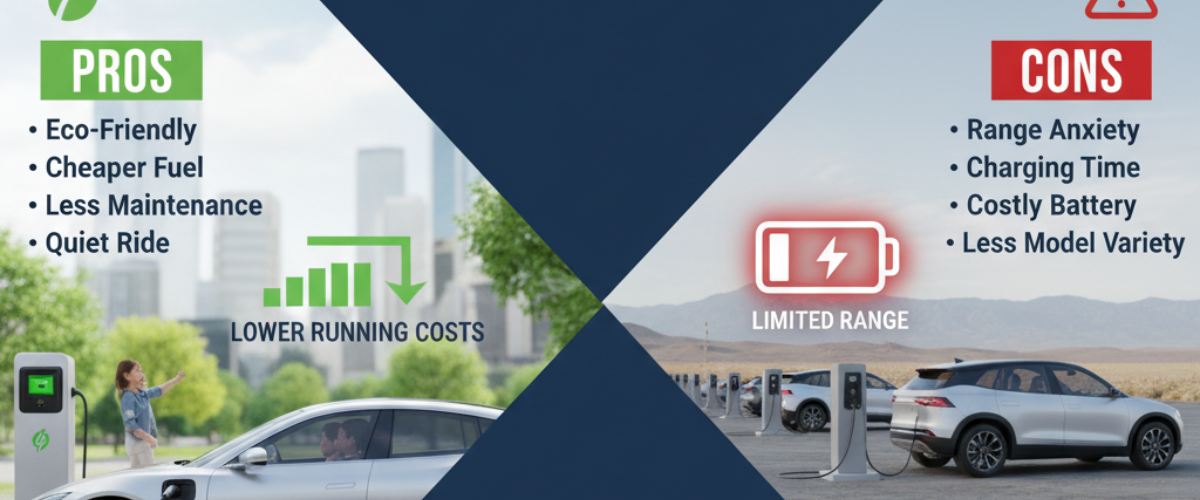
PROS OF EV CARS (Explained in Detail)
1. Environment-Friendly and Zero Emissions
Electric vehicles contribute significantly to reducing air pollution. With no exhaust pipe, EVs emit zero pollutants such as carbon monoxide, nitrogen oxides, or particulate matter. This is especially beneficial for densely populated Indian cities, where air quality often falls below permissible limits.
Choosing an EV means choosing cleaner air—an investment in public health and the environment.
2. Much Lower Running Cost
The biggest financial advantage of EVs is the low cost-per-kilometer.
- EV charging: ₹1–2 per km
- Petrol car: ₹8–10 per km
- Diesel car: ₹6–7 per km
For daily commuters who drive 40–60 km every day, the monthly savings can easily reach ₹4,000–₹10,000. Over several years, EV owners can save lakhs simply through reduced fuel expenses.
3. Smooth, Silent, and Instant Acceleration
Electric motors deliver instant torque, meaning the moment you accelerate, the car responds immediately. There is no engine noise, no clutch vibration, and no gear shifts. This provides:
- A smoother ride
- Quicker acceleration
- A peaceful in-cabin experience
For city traffic, where stop-and-go driving is common, EVs feel effortless and refined.
4. Low Maintenance and Fewer Mechanical Parts
EVs have far fewer moving parts compared to petrol or diesel cars. Key components like the engine, transmission, clutch, timing belt, spark plugs, and fuel pump simply do not exist in EVs.
Maintenance advantages include:
- No engine oil changes
- Fewer fluid replacements
- Lower risk of mechanical failure
- Reduced workshop visits
Over the long term, EV maintenance can cost 50–70% less than regular cars.
5. Government Subsidies and Financial Benefits
To accelerate EV adoption, governments are offering multiple benefits:
- State-level subsidies under FAME-II
- Reduced road tax or zero tax in some states
- Lower registration charges
- Incentives for commercial EV buyers
- Cheaper parking rules in some cities
These schemes significantly lower the effective price of EVs, making them more accessible.
6. Easy Home Charging Convenience
One of the biggest advantages of EV ownership is home charging. Imagine waking up every morning with a fully charged car—no more petrol pump visits, fuel lines, or fluctuating fuel prices.
For people with stable daily travel, home charging provides unmatched convenience and peace of mind.
CONS OF EV CARS (Explained in Detail)
1. High Upfront Price
Even though operational costs are low, EVs are still more expensive to purchase due to costly lithium-ion batteries. In the same segment, an EV can cost ₹2–5 lakhs more than a petrol or diesel model.
For budget-conscious buyers, this initial price difference can be a dealbreaker.
2. Limited Range for Long Trips
Most affordable EVs offer 150–300 km of real-world range. While this is adequate for urban use, it may fall short for long-distance travel.
Drivers often worry about:
- Running out of charge
- Traffic delays affecting range
- Fast chargers not being available
This fear is known as range anxiety, and it remains one of the biggest hurdles for EV adoption.
3. Long Charging Time
Compared to refilling fuel in 3–5 minutes, EV charging is significantly slower.
- Home charging: 6–10 hours (night charging)
- Fast charging: 45–90 minutes for 0–80%
This means EVs require thoughtful planning, especially for road trips or unplanned travel. If you forget to charge at night, you may face delays the next morning.
4. Weak Charging Infrastructure in Many Areas
While metro cities have seen rapid growth in EV charging stations, the situation is different in:
- Tier II and Tier III cities
- Highways and rural areas
- Small towns with limited electricity availability
For long-distance travel, finding a reliable fast-charging station can still be challenging. This can add stress and increase travel time during road trips.
5. Battery Degradation Over Time
Just like mobile phones, EV batteries lose capacity as they age. After years of usage, the range may decrease, affecting the car’s practicality.
Replacing the battery is expensive and can cost 30–50% of the car’s value. While manufacturers offer warranties (usually 6–8 years), battery ageing remains a concern for long-term ownership.
6. Not Suitable for Every User Type
EVs are ideal for users who:
- Drive mostly in the city
- Have stable daily travel patterns
- Have access to home/work charging
- Want low running and maintenance costs
EVs may not be suitable for those who:
- Drive long distances regularly
- Live in rural or semi-urban areas
- Cannot install a home charging system
- Need quick fueling without waiting
Your lifestyle, geography, and usage pattern must align with what EVs offer.
FINAL CONCLUSION — Should You Buy an EV?
EVs are an excellent choice for urban users looking for smooth performance, low running costs, and an environmentally responsible option. They align perfectly with daily city driving and predictable travel routines.
However, if you travel long distances, live in regions with limited charging stations, or require quick refueling without planning, a petrol, diesel, or hybrid car may be a more practical choice.
At CarJD, our goal is simple:
To give you honest, unbiased, and real-world car insights—not marketing hype.
Whether your next vehicle is an EV, petrol, diesel, or hybrid, we help you select the option that matches your budget, lifestyle, and long-term needs.
- If you want, I can now create:
A short Instagram caption version
A LinkedIn-ready summary
A full YouTube script
SEO title + meta description
Carousel text for Insta/Facebook