18 Nov 2025 • SuGanta International.
E20 Petrol: Pros and Cons
E20 petrol, a blend of 20% ethanol and 80% petrol, is becoming the new standard for India’s future mobility. It reduces pollution, lowers fuel import dependency, and supports farmers by increasing ethanol demand. However, not all cars are compatible with E20 yet, and users may experience reduced mileage and faster wear of rubber and metal parts in older engines. Understanding these advantages and drawbacks helps buyers and car owners make informed decisions before switching to E20 fuel.
India is moving toward cleaner and more sustainable fuel options, and one of the biggest steps in this direction is the introduction of E20 petrol. Unlike regular petrol, which contains only a small percentage of ethanol, E20 petrol is a blend of 20% ethanol and 80% petrol. This shift is part of the government’s long-term plan to reduce pollution, support farmers, and make India less dependent on imported crude oil. But many car owners still have one big question: Is E20 good for my car?
What is E20 Petrol?
E20 petrol is a fuel mixture where 20% of the fuel is ethanol, which is an alcohol made from sugarcane, corn, grains, and agricultural waste. The remaining 80% is regular petrol. Ethanol is a renewable fuel, which means it can be produced repeatedly from natural plant sources. This makes E20 a cleaner and more sustainable alternative compared to traditional petrol.
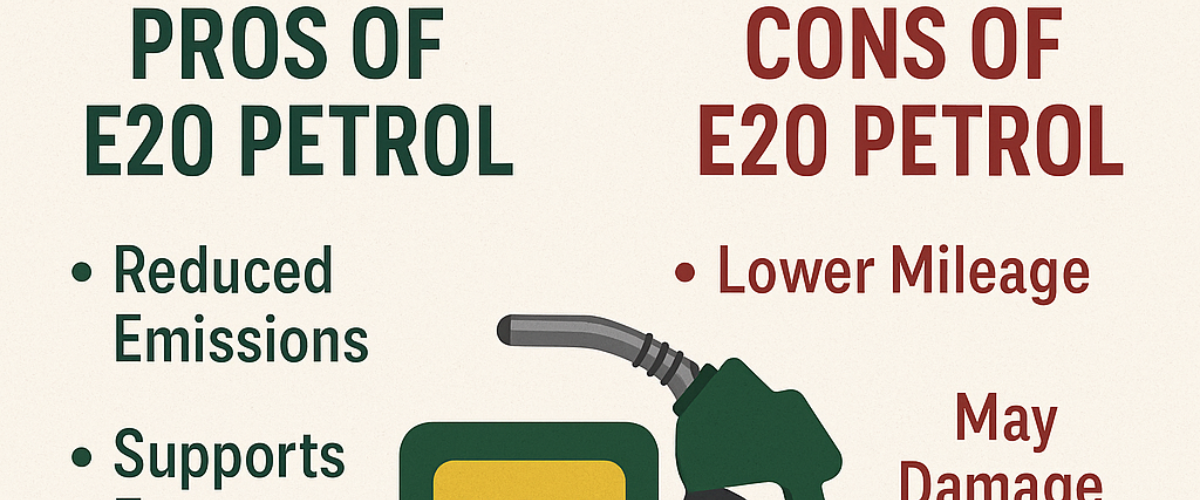
Pros of E20 Petrol
E20 petrol brings several benefits, especially on an environmental and economic level. One of the biggest advantages is that it burns much cleaner than ordinary petrol. Since ethanol is a plant-based fuel, it releases fewer harmful gases, helping reduce air pollution. As cities continue to struggle with rising pollution levels, using E20 can contribute to cleaner air and a healthier environment. It reflects a shift towards green mobility, which is becoming a necessity today.
Another important benefit is that E20 petrol supports Indian farmers. Ethanol is made from agricultural products like sugarcane and grains, so increased ethanol use means more demand for these crops. This gives farmers additional income and strengthens rural industries. Instead of importing fuel from other countries, India can depend more on its own agricultural output, which is good for the economy.
E20 petrol also reduces India’s dependence on imported crude oil. Since a large portion of our petrol comes from other countries, the more ethanol we use, the more we save on foreign exchange. Over time, this can make the country more energy-independent.
Some E20-compatible cars may also show better engine performance. Ethanol has a higher octane rating, which helps engines run smoothly and reduces knocking. Many modern engines designed for blended fuels deliver smoother acceleration and cleaner combustion when running on E20.
Cons of E20 Petrol
Although E20 petrol has several benefits, it also comes with certain limitations that every vehicle owner must understand. One major drawback is reduced mileage. Ethanol has less energy than petrol, which means that E20 fuel generally gives lower fuel efficiency. In simple words, your car may consume more fuel to travel the same distance compared to regular petrol. For people who drive long distances every day, this could increase monthly fuel expenses.
Another issue is compatibility. Not all cars on the road today are designed to run on E20. Vehicles manufactured previously—especially before 2020—may face problems if E20 is used regularly. Ethanol can react with rubber seals, fuel lines, and certain metals inside older engines, leading to corrosion and long-term damage. This may cause higher maintenance costs. Before switching to E20, it is important for every owner to check the car’s manual or confirm with the manufacturer whether the engine is E20-ready.
E20 fuel also requires better fuel management because ethanol absorbs more moisture from the air. Excess moisture can cause rust in the fuel tank, reduce engine lubrication, and affect fuel purity. Cars that are not designed for ethanol-rich fuel may face starting problems, especially during cold weather, because ethanol vaporizes more slowly than petrol.
Another concern is the limited availability of E20 across India. While major cities are getting E20 pumps, smaller towns and rural areas may still rely on regular petrol. Those who frequently travel across states may face inconvenience if E20 is not available everywhere.
Should You Switch to E20 Petrol?
Choosing E20 petrol depends mainly on your car model, fuel availability, and driving habits. If your vehicle is new and has been certified as E20-compatible, switching to this fuel is safe and environmentally beneficial. It is ideal for people who mostly drive in the city, have predictable daily travel, and want to support cleaner fuel initiatives.
However, if you own an older car or do a lot of highway driving, switching to E20 may not be the best idea right now. Lower mileage, possible engine impact, and uncertain availability could create inconvenience.
For detailed car comparisons, reviews, and information about E20-ready vehicles, you can Check Now
Final Conclusion
E20 petrol is clearly the future of sustainable mobility in India. It supports the environment, boosts the agriculture sector, reduces the country’s reliance on imported oil, and encourages green energy growth. But at the same time, it has challenges—especially for vehicles that are not compatible with ethanol-rich fuel. Reduced mileage and potential engine issues make it important for buyers to make informed decisions.
In simple words, E20 is a smart choice only if your car is designed for it.
If your vehicle is older or you drive long distances frequently, traditional petrol or a hybrid engine may be more practical.
As India prepares for a greener automotive future, understanding the pros and cons of E20 fuel helps you stay one step ahead. And at CarJD, we aim to provide honest, unbiased information to help you choose the right vehicle for your needs.